Tag: Germany Student Visa

  • Why Germany Is the Number One Choice for Indian Students in 2026
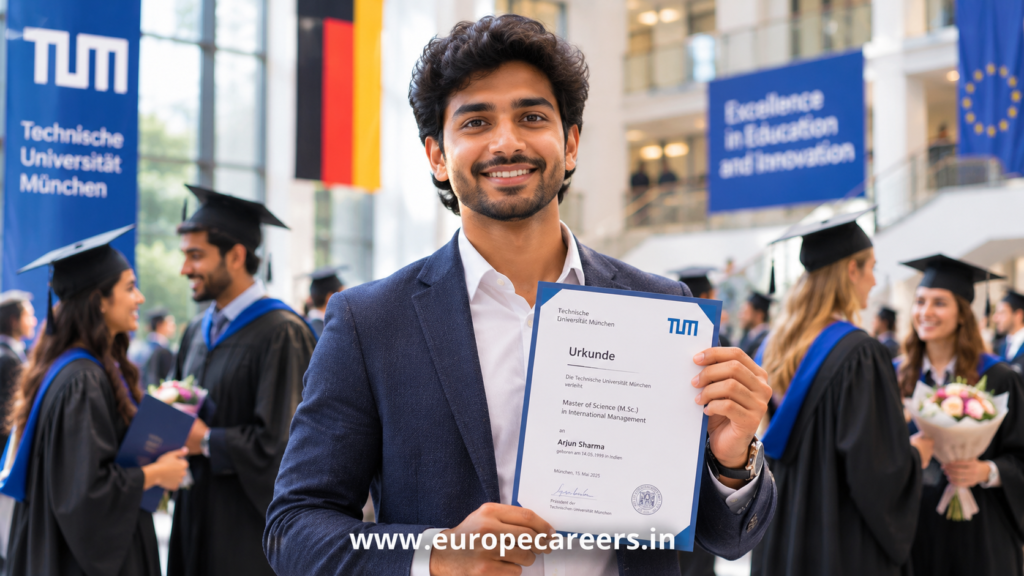
    Why Germany Is the Number One Choice for Indian Students in 2026

    Every year lakhs of Indian students ask the same question.

    Where should I go for higher education abroad?

    UK? Too expensive.
    USA? Visa is unpredictable.
    Canada? Getting harder every year.
    Australia? Costs are rising fast.

    And then there is Germany.

    No tuition fees at public universities. World class education. An 18 month job search visa after graduation. A clear path to permanent residency and eventually an EU passport.

    It is no surprise that over 60,000 Indian students are currently studying in Germany — making India the single largest source of international students in the entire country.

    This guide by EuropeCareers covers everything you need to know about studying in Germany as an Indian student in 2026 — from choosing your university to getting your visa — written in simple English so nothing gets confusing.


    Why Germany — The Big Reasons

    Before we get into the process, let us understand why Germany makes so much sense for Indian students specifically.

    Almost Zero Tuition Fees
    Public universities in Germany charge almost no tuition fees — even for international students. You pay only a semester contribution of approximately 250 to 500 euros per semester. This covers your student ID, public transport pass, and administrative costs. Compare this to 20 to 40 lakh rupees per year in the UK or USA and the difference is enormous.

    World Class Universities
    Germany is home to some of the best universities in the world. TU Munich, RWTH Aachen, Heidelberg University, LMU Munich, and Humboldt University Berlin are globally ranked institutions that employers across the world recognise and respect.

    Over 2000 English Taught Programmes
    You do not have to learn German to study in Germany. Germany now offers over 2000 programmes taught entirely in English — mainly at the Master’s level. Engineering, Computer Science, Business, Data Science, and many more fields are available in English.

    18 Month Job Search Visa After Graduation
    After completing your degree in Germany, you automatically get an 18 month residence permit to stay in Germany and look for a job. No other country gives you this much time. You do not need a job offer before you graduate.

    Path to Permanent Residency
    Once you get a job in Germany after graduation, you can apply for permanent residency in as little as 21 months. After five years you can apply for German citizenship — giving you the right to live and work freely across all 27 European Union countries.

    Safe, Organised, and Student Friendly
    Germany is one of the safest countries in the world. Cities are clean and well connected. Public transport is excellent. Student life is affordable. And Germany has one of the largest Indian communities in Europe.


    Step 1 — Decide What You Want to Study

    The first step is choosing your field of study and degree level.

    Germany offers programmes at three levels:

    Bachelor’s Degree: Three to four years. Taught mostly in German. Requires Class 12 plus additional eligibility steps for Indian students.

    Master’s Degree: One and a half to two years. Most English taught programmes are at this level. Requires a relevant bachelor’s degree from India.

    PhD / Doctoral Degree: Three to five years. Often fully funded with a monthly stipend. Requires a strong master’s degree and a research proposal.

    For Indian students, the Master’s degree is the most popular and most straightforward pathway — because most programmes are in English, the admission process is cleaner, and the career outcomes are excellent.

    The most popular fields among Indian students in Germany are:

    Computer Science and IT, Mechanical Engineering, Electrical Engineering, Automotive Engineering, Data Science and Artificial Intelligence, Business Administration and MBA, Biotechnology and Life Sciences, Architecture and Urban Planning, and Economics and Finance.


    Step 2 — Check If You Are Eligible

    Eligibility in Germany depends on your degree level and your academic background.

    For Bachelor’s Programmes:

    Indian students with a Class 12 certificate cannot directly apply for a bachelor’s programme in Germany. Germany requires 13 years of school education and India has 12. This one year gap must be bridged.

    You have two options to bridge this gap:

    Option one is to complete one year of a bachelor’s degree at a recognised Indian university after Class 12. After completing one successful year, you become eligible to apply for a German bachelor’s programme in a related field.

    Option two is to attend a Studienkolleg in Germany. This is a one year foundation course run by German universities specifically for international students. You attend classes in German, study your core subjects, and then sit a final exam called the Feststellungsprüfung. Passing this exam makes you eligible for university admission.

    From Winter Semester 2026/27 onwards, a minimum of 70 percent marks in Class 12 is required for both the Studienkolleg pathway and the direct subject restricted admission pathway.

    For Master’s Programmes:

    You need a recognised bachelor’s degree from an Indian university in a relevant or related field. Most universities require between 60 and 70 percent marks in your bachelor’s degree. Some top universities require higher.

    Your Indian university must be recognised by German authorities. You can check this on a database called Anabin, which German universities use to verify Indian institutions. Most established Indian universities — central universities, IITs, NITs, and recognised private universities — are listed and accepted.

    For PhD Programmes:

    You need a master’s degree in a relevant field. You also need to find a professor or research supervisor at a German university who agrees to supervise your research. PhD positions are often advertised like jobs and come with a monthly salary or stipend.


    Step 3 — The APS Certificate — Do Not Skip This

    This is the step that catches most Indian students off guard.

    Since November 2022, all Indian students applying to German universities must obtain an APS Certificate before they can apply for a student visa.

    APS stands for Akademische Prüfstelle — which is the Academic Evaluation Centre operated by the German Embassy in India.

    The APS certificate verifies that your academic documents — your Class 12 marksheet, your bachelor’s degree, your transcripts — are genuine and meet German academic standards. Without this certificate, the German Embassy will not process your student visa.

    How the APS process works:

    You register online on the APS India website and submit your academic documents. APS verifies your documents and schedules an interview with you. The interview is in person at the German Embassy or a designated centre. After passing the interview, you receive your APS certificate.

    How long does it take?

    The APS process typically takes four to eight weeks from the time you submit your documents. Some students report it taking longer during busy application seasons.

    When should you apply for APS?

    If you are targeting the Winter Semester 2026/27 intake — which begins in October 2026 — you should apply for your APS certificate by March 2026 at the latest. This gives you enough time to receive the certificate before university application deadlines.

    APS Fee:

    The APS certificate costs approximately 150 to 200 euros.

    This step is mandatory. There are no exceptions. Start your APS process early — it is one of the most common reasons Indian students miss their application deadline.


    Step 4 — Language Requirements

    Germany has two types of programmes — German taught and English taught. Your language requirement depends entirely on which type you are applying for.

    If you are applying for a German taught programme:

    You need to prove German language proficiency. The minimum requirement is B2 level on the CEFR scale. Most universities prefer C1 for undergraduate programmes and for medical or law programmes.

    The recognised German language tests are:

    TestDaF — Test Deutsch als Fremdsprache. This is the most widely accepted German language test for university admission. You need TDN 4 in all four components for most programmes.

    DSH — Deutsche Sprachprüfung für den Hochschulzugang. This exam is conducted by German universities themselves and is taken after arriving in Germany, usually after completing Studienkolleg.

    Goethe-Zertifikat B2 or C1 — Accepted by most universities and available at Goethe-Institut centres across India in cities like Delhi, Mumbai, Kolkata, Pune, and Bengaluru.

    If you are applying for an English taught programme:

    You need to prove English language proficiency. The most commonly required tests and scores are:

    IELTS Academic — minimum 6.0 to 6.5 depending on the university and programme. This is the most widely accepted English test at German universities.

    TOEFL iBT — minimum 80 to 90 for most programmes.

    PTE Academic — accepted by some universities. Check your specific programme requirements.

    Many German universities will waive the English language test if your bachelor’s degree was taught entirely in English at a recognised Indian university. However this waiver is not guaranteed. It is safer to take IELTS regardless.

    Important for visa purposes:

    Even if you are applying for an English taught programme, you need a minimum of A1 level German for your student visa application at the German Embassy. A1 is a very basic level — two to three months of casual study is usually enough to clear it.


    Step 5 — Choose Your University and Apply

    Germany has over 400 universities offering thousands of programmes. Choosing the right one requires research and planning.

    Types of universities in Germany:

    Universität — Research universities offering programmes across all disciplines. Generally more prestigious for science, arts, and research based fields.

    Technische Universität — Technical universities specialising in engineering, technology, science, and related fields. TU Munich, RWTH Aachen, and TU Berlin are among the most respected in the world.

    Fachhochschule — Universities of Applied Sciences. These focus on practical, industry oriented education. They have smaller class sizes, strong industry connections, and good employment outcomes. Excellent choice for engineering, business, and design programmes.

    Hochschule — Another term for University of Applied Sciences, used interchangeably with Fachhochschule in some states.

    Public vs Private Universities:

    Public universities in Germany are almost free. Private universities charge tuition fees ranging from 5,000 to 20,000 euros per year. Most top ranked universities in Germany are public. Always verify that a private university is state accredited before applying — not all private universities in Germany are recognised by the German government.

    How to apply:

    Most German universities use one of two application systems:

    Direct Application — You apply directly through the university’s own online portal. Many universities accept direct applications, especially for Master’s programmes.

    Uni-Assist — A central application service used by many German universities. You submit all your documents once through Uni-Assist and they evaluate your credentials and forward your application to the universities you have chosen. There is a fee of approximately 75 euros for the first university and 30 euros for each additional university through Uni-Assist.

    Important application deadlines for 2026:

    Winter Semester 2026/27 starts in October 2026. Most university application deadlines fall between May and July 15, 2026. Some top universities close applications as early as May or June. Always check your specific university’s official website for exact deadlines.

    Summer Semester 2027 starts in April 2027. Application deadlines fall between November 2026 and January 2027. Fewer programmes are available in the Summer Semester — most Indian students target the Winter Semester.


    Step 6 — Documents You Need for University Application

    When applying to German universities, you will need the following documents. Prepare these well in advance as getting certified translations and notarised copies takes time.

    Academic documents — Class 10 and Class 12 marksheets and certificates, bachelor’s degree certificate and all semester marksheets, master’s degree documents if applying for PhD.

    Language certificates — Your TestDaF, DSH, Goethe, IELTS, TOEFL, or PTE results.

    APS Certificate — Mandatory for all Indian applicants.

    Statement of Purpose — A personal essay explaining why you want to study this programme at this university, what your academic background is, and what your career goals are. This is one of the most important documents for Master’s applications. Write it carefully and tailor it to each university.

    Letters of Recommendation — Most Master’s programmes require two to three academic or professional references. Request these from your professors or employers well in advance.

    CV or Resume — A German style CV is preferred. Keep it concise, factual, and professional. German CVs typically include a professional photo.

    Portfolio — Required for design, architecture, and arts programmes.

    GRE or GMAT scores — Some engineering and business programmes require these, though many German universities do not. Check your specific programme requirements.

    All documents not originally in German or English must be accompanied by certified translations by a sworn translator.


    Step 7 — The Blocked Account — Show Germany You Have Money

    Once you have your admission letter, you need to open a Blocked Account before applying for your visa.

    A Blocked Account — called Sperrkonto in German — is a special bank account that proves you have enough money to support yourself during your first year of study in Germany.

    The required amount for 2026 is 11,904 euros for the full year — which equals 992 euros per month. This amount is set by the German government and adjusts each year.

    The money is locked — you cannot withdraw the full amount at once. You receive 992 euros per month as a living allowance. This is the government’s way of ensuring you can support yourself without working illegally or depending on public funds.

    How to open a Blocked Account:

    There are several providers that Indian students commonly use. Fintiba and Expatrio are the most popular because they are fully online, accept Indian documentation, and process applications quickly. Deutsche Bank is the traditional option but may require a branch visit. Setup fees range from approximately 49 to 89 euros depending on the provider.

    Recommended timeline:

    Open your blocked account at least six to eight weeks before your visa appointment. Late funding is one of the most common reasons Indian students face visa delays.

    In Indian rupees, 11,904 euros is approximately 10.5 to 11 lakh rupees at current exchange rates. Plan this financial requirement carefully well before your application season.


    Step 8 — Health Insurance — Mandatory Before You Arrive

    Health insurance is not optional in Germany. It is compulsory for every student and must be arranged before you arrive.

    Germany has two types of health insurance — public statutory insurance and private insurance.

    For students under 30 years of age, public statutory health insurance is the recommended option. The monthly premium is approximately 110 to 120 euros per month and covers almost all medical costs including doctor visits, hospital stays, medicines, specialist consultations, and mental health services.

    For students over 30 years of age, public statutory insurance is not available at the student rate. You will need to arrange private health insurance, which is typically more expensive.

    Most German universities require proof of health insurance before they will complete your enrolment. Your insurance provider sends confirmation directly to the university digitally in most cases.

    Major public health insurance providers that accept international students include TK Techniker Krankenkasse, AOK, Barmer, and DAK Gesundheit.


    Step 9 — Apply for Your German Student Visa

    With your admission letter, APS certificate, blocked account confirmation, and health insurance in place, you are ready to apply for your German Student Visa — also called the National Visa Type D.

    Where to apply:

    Depending on where you live in India, you apply either at the German Embassy in New Delhi or at German Consulates in Mumbai, Chennai, or Bengaluru. Some applicants in certain regions use VFS Global centres. Check which German mission is responsible for your area before booking.

    Key documents for your visa application:

    Valid passport with at least one year of validity remaining and two empty pages. Completed and signed visa application form. Two recent biometric passport photographs. Admission letter from your German university. APS certificate. Blocked account confirmation letter showing 11,904 euros. Proof of health insurance. Academic documents — Class 12 and bachelor’s certificates and marksheets. Language certificate — IELTS, TestDaF, or Goethe as applicable. APS certificate. CV and statement of purpose in some cases.

    Submit originals with two copies of each document.

    Visa fee: 75 euros.

    Processing time: Three to four months is the average processing time for Indian students. Some applicants report faster processing. Book your visa appointment as early as possible — appointments at German missions in India are in high demand and slots fill up quickly.

    After arriving in Germany:

    Your student visa is typically valid for three months. After arriving in Germany, you must register your address at the local Einwohnermeldeamt — the residents registration office — and then apply for a Student Residence Permit at the Ausländerbehörde — the foreigners authority. This converts your visa into a residence permit valid for the duration of your studies.


    Step 10 — Scholarships for Indian Students

    Germany offers excellent scholarship opportunities. Since public universities already charge no tuition fees, scholarships mainly cover your living expenses — which is exactly what you need.

    DAAD Scholarship — Deutscher Akademischer Austauschdienst

    DAAD is Germany’s largest scholarship organisation and one of the most respected in the world. It offers scholarships for Indian students at bachelor’s, master’s, and PhD level.

    The standard DAAD monthly stipend is 992 euros for Master’s students and 1,300 euros for PhD candidates. This also includes a travel allowance and a contribution toward health insurance.

    DAAD scholarships are competitive. You need strong academic results, a clear research or study purpose, and excellent language skills. Application deadlines vary by programme — check the official DAAD website early.

    Deutschlandstipendium — Germany Scholarship

    A merit based scholarship offered by German universities in partnership with private companies and foundations. It pays 300 euros per month for at least two semesters. Awarded directly by your university. Check your university’s website to apply.

    University Specific Scholarships

    Many German universities offer their own scholarships and fee waivers for international students with outstanding academic records. These are listed on each university’s international office website.

    Erasmus Plus

    If you are already enrolled at an Indian university that has a partnership with a European university, you may be eligible for Erasmus Plus funding to study or do a research exchange in Germany. Check with your Indian university’s international office.

    State Government Scholarships

    Several German state governments offer scholarships for international students. Baden-Württemberg, Bavaria, and North Rhine-Westphalia have active scholarship programmes.


    Cost of Living in Germany for Indian Students

    Understanding costs is essential for financial planning. Here is a realistic monthly budget for an Indian student in Germany in 2026.

    Expense Monthly Cost (Euros) Approximate INR
    Rent (student dormitory) 250 to 450 22,000 to 40,000
    Rent (private apartment) 500 to 900 44,000 to 80,000
    Food and groceries 150 to 250 13,000 to 22,000
    Public transport 0 to 50 Included in semester fee
    Health insurance 110 to 120 9,700 to 10,600
    Mobile phone 10 to 20 900 to 1,800
    Entertainment and personal 50 to 100 4,400 to 8,800
    Total monthly 600 to 950 53,000 to 84,000

    City wise cost comparison:

    Munich and Frankfurt are the most expensive cities in Germany. Hamburg, Stuttgart, and Cologne are moderately priced. Berlin, despite being the capital, is relatively affordable for a major European city. Leipzig, Aachen, Dortmund, Dresden, and Hannover are the most affordable university cities — excellent choices for students wanting to maximise savings.

    Student dormitory vs private apartment:

    Student dormitories — called Studentenwohnheim — are managed by the Studentenwerk and are significantly cheaper than private apartments. However demand is very high and waiting lists can be long. Apply for dormitory accommodation as soon as you receive your admission letter. Do not wait.


    Working While Studying in Germany

    One of the most practical benefits of studying in Germany is the right to work part time while completing your degree.

    As an Indian student on a student visa in Germany, you are allowed to work up to 140 full days or 280 half days per year without needing any additional work permit. This is built into your student residence permit automatically.

    At Germany’s minimum wage of 12.41 euros per hour in 2026, working even 20 hours per week can add 800 to 1,000 euros per month to your income — significantly reducing your cost of living pressure.

    Common student jobs in Germany include working at university cafeterias called Mensa, student assistant positions at your university called Hiwi Jobs, retail and supermarket jobs, delivery and logistics work, restaurant and cafe work, and IT support and technical roles for students with relevant skills.

    Many Indian students also find internships and working student positions — called Werkstudent in German — at German companies during their studies. These positions pay significantly more than regular part time jobs, typically 12 to 20 euros per hour, and often lead to full time job offers after graduation.


    After Graduation — Your Options in Germany

    Graduating from a German university opens excellent doors. Here is what happens after you complete your degree.

    18 Month Job Search Visa

    After graduating, you automatically receive an 18 month residence permit to stay in Germany and look for a job in your field. You can work in any job during this period to support yourself while you search. This is one of Germany’s most student friendly policies.

    EU Blue Card

    Once you find a job matching your qualification, you can apply for the EU Blue Card — Germany’s skilled worker residence permit for university graduates. It requires a minimum annual salary of 45,934 euros for shortage occupations and IT roles, and 50,700 euros for other professions. The EU Blue Card gives you and your family the right to live and work in Germany long term.

    Permanent Residency

    With the EU Blue Card and continuous employment, you can apply for permanent residency in just 21 months — or 33 months on a regular skilled worker visa. Permanent residency means you can live and work in Germany forever without renewing any permit.

    German Citizenship

    After five years of legal residence in Germany, you can apply for German citizenship. Germany also allows dual citizenship under certain conditions, meaning you may be able to keep your Indian passport as well. German citizenship gives you the right to live, work, and study across all 27 EU countries freely.


    Top German Universities for Indian Students

    These are the most popular and highly regarded universities among Indian students in 2026:

    TU Munich — Technische Universität München
    Consistently Germany’s top ranked university. Exceptionally strong in engineering, computer science, and natural sciences. Located in Munich — Germany’s most prosperous city.

    RWTH Aachen University
    One of Europe’s leading technical universities. Particularly strong in mechanical engineering, automotive engineering, and materials science. Strong industry connections with German manufacturing companies.

    Heidelberg University
    Germany’s oldest university. Globally renowned for life sciences, medicine, and humanities. Excellent research environment.

    LMU Munich — Ludwig Maximilian University
    A top ranked research university strong in medicine, law, economics, and sciences. Located in Munich alongside TU Munich.

    TU Berlin — Technische Universität Berlin
    Strong in engineering, computer science, and urban planning. Located in Germany’s capital — excellent for networking and startup culture.

    University of Hamburg
    Strong in business, economics, law, and sciences. Hamburg is Germany’s second largest city and a major international business hub.

    Karlsruhe Institute of Technology
    Top ranked for engineering, physics, and computer science. Often called the MIT of Germany.

    University of Stuttgart
    Excellent for automotive, mechanical, and electrical engineering. Located in the heart of Germany’s automotive industry.

    University of Mannheim
    Germany’s top business school. Consistently ranked among the best business universities in Europe.

    FAU Erlangen-Nürnberg
    Strong in engineering and sciences. Good value for quality — lower cost of living than Munich with excellent academic standards.


    Frequently Asked Questions

    Can Indian students study in Germany for free?
    Yes. Public universities in Germany charge almost no tuition fees — only a semester contribution of 250 to 500 euros per semester. This applies to international students including Indians. Private universities do charge fees but most top programmes are at public universities.

    Do I need to know German to study in Germany?
    Not necessarily. Germany offers over 2000 programmes in English — mainly at the Master’s level. For English taught programmes, you only need IELTS or TOEFL and A1 German for your visa. For German taught programmes, you need B2 or C1 level German.

    What is the APS certificate and is it mandatory?
    The APS certificate is a document verification issued by the German Embassy in India confirming that your academic documents are genuine. It is mandatory for all Indian students applying for a German student visa since November 2022. Without it your visa will not be processed.

    How much money do I need to show for a Germany student visa?
    You need to deposit 11,904 euros — approximately 10.5 to 11 lakh rupees — into a Blocked Account. This money is released to you at 992 euros per month while you study.

    Can I work while studying in Germany?
    Yes. Indian students can work up to 140 full days or 280 half days per year without any additional permit. At German minimum wage this can earn you 800 to 1,000 euros per month to support your living costs.

    What happens after I finish my degree in Germany?
    You get an automatic 18 month job search visa to stay in Germany and find a job. Once employed, you can get the EU Blue Card and apply for permanent residency in as little as 21 months.

    Is IELTS compulsory for studying in Germany?
    For English taught programmes, IELTS, TOEFL, or PTE is required. Some universities waive this if your bachelor’s was taught in English — but it is not guaranteed. For German taught programmes, TestDaF or Goethe B2/C1 is needed instead. A1 German is needed for all students at the visa stage.

    What is Studienkolleg?
    Studienkolleg is a one year foundation programme in Germany for international students who do not yet meet the full admission requirements for a bachelor’s degree. It bridges the gap caused by India’s 12 year school system versus Germany’s 13 year requirement. After completing Studienkolleg and passing the final exam, you are eligible to apply for a bachelor’s programme.


    Complete Timeline for Indian Students — From Decision to Arrival

    Timeline What to Do
    18 months before Research programmes and universities. Begin German or IELTS preparation.
    15 months before Start APS document collection and verification process.
    12 months before Apply for APS certificate. Continue language preparation.
    10 months before Receive APS certificate. Finalise university shortlist.
    8 months before Submit university applications via direct portal or Uni-Assist.
    6 months before Receive admission letter. Open Blocked Account. Arrange health insurance.
    4 months before Apply for student visa at German Embassy or Consulate.
    2 months before Receive visa. Book flights. Apply for student dormitory.
    Arrival in Germany Register address at Einwohnermeldeamt. Apply for residence permit. Enrol at university.

    Conclusion: Germany Is the Smartest Study Abroad Decision for Indian Students in 2026

    If you are an Indian student looking for quality education abroad without spending crores of rupees, Germany is the answer.

    Free tuition at world class universities. Over 2000 English taught programmes. An 18 month job search visa. Permanent residency in 21 months. German citizenship and an EU passport within five years. The right to work while studying. A safe, organised, and welcoming country with a large Indian community.

    The process has multiple steps — APS certificate, blocked account, language tests, visa application — and it requires careful planning and a realistic timeline of 12 to 18 months from start to arrival.

    But for students who plan well and start early, Germany offers a study abroad experience that no other country can match at this price point.

    At EuropeCareers, we help Indian students navigate every step of the Germany journey — from choosing the right programme to getting your visa approved. Germany is waiting. Start planning today.