Germany is the dream destination for thousands of Indian students every year. Zero tuition fees at public universities, world-class education, and an 18-month post-study work visa make it one of the most attractive European countries to study in. But here is the question every Indian family asks first — how much money do we actually need?
This article gives you the complete honest answer. Every cost is explained clearly — from the blocked account to monthly rent, food, transport, health insurance, APS certificate, and visa fee. All amounts are given in both Euros and Indian Rupees so you can plan your budget from India without any confusion.
Note: All Indian Rupee figures in this article are calculated at 1 Euro equal to approximately 109.97 Indian Rupees, which is the approximate rate as of September 2026. Exchange rates change regularly so always check the current rate before transferring money.
The Most Important Thing to Understand Before Reading This Article
 Many Indian students and parents search for the cost of studying in Germany and assume that because tuition is free, Germany is very cheap. That is not completely true.
Tuition at most German public universities is indeed free or almost free. But Germany is a developed European country with a real cost of living. Accommodation, food, health insurance, and daily expenses add up. The German government itself requires you to prove you have enough money to live in Germany before they give you a student visa.
So the question is not just about tuition fees. The real question is — what is the total money needed from Day 1 of applying to Germany until you complete your degree and stand on your own feet. This article answers exactly that.
Part 1 — Money You Need Before You Even Leave India
Before you board your flight to Germany, there are several costs you have to pay from India. These are one-time costs that most students overlook when budgeting.
APS Certificate Fee — The First Cost Every Indian Student Pays
The APS certificate is mandatory for every Indian student applying to study in Germany. APS stands for Akademische Prüfstelle. It is a document verification process done at the German Embassy in New Delhi that confirms your Indian academic certificates are genuine and meet German standards.
Without the APS certificate, you cannot apply for a German university admission properly, and you cannot book your visa appointment in 2026. Most German consulates will not allow you to book a visa appointment without your APS number.
The APS certificate fee is approximately 18,000 Indian Rupees. This is a one-time payment made by bank transfer to the APS India office. The processing time is 3 to 4 weeks, but can take up to 6 to 8 weeks during peak season. Apply for this as early as possible — ideally 4 to 5 months before your intended start date.
The APS certificate once issued is valid for an unlimited period of time. Digital APS certificates are issued in a secure PDF format validated by a digital signature.
Blocked Account — The Biggest Financial Requirement for Germany
 This is the most important financial requirement for studying in Germany and every Indian student must understand it fully.
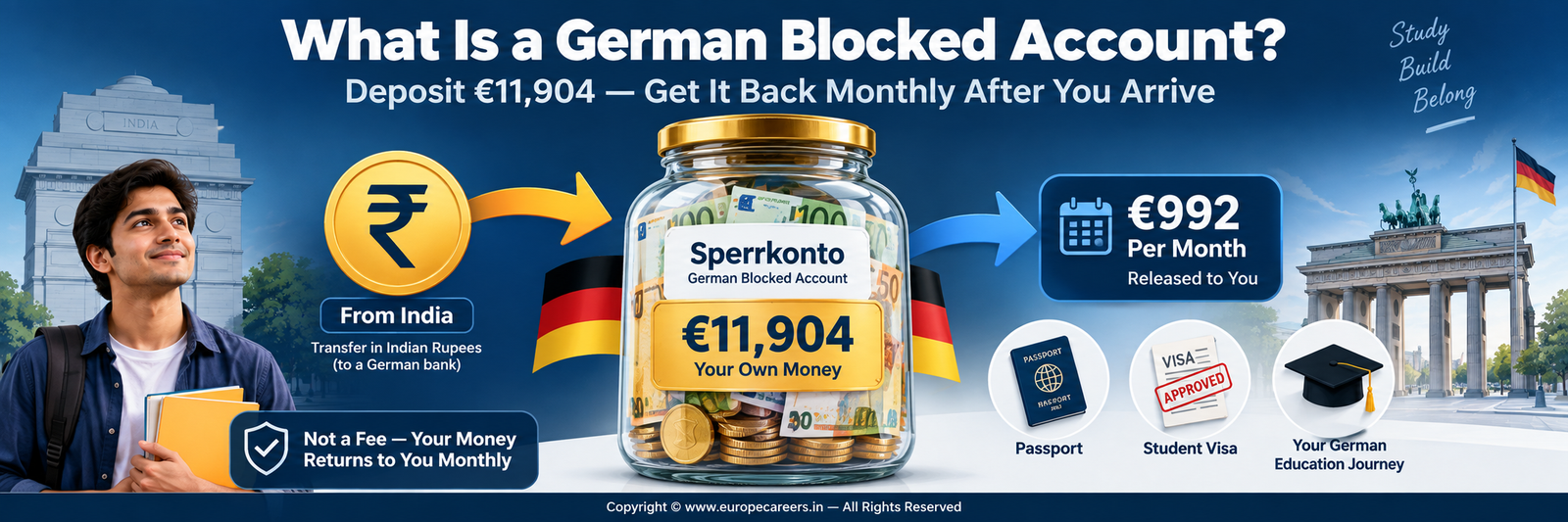
The German government requires all non-EU international students to prove they have enough money to live in Germany before issuing a student visa. The way you prove this is by opening a German Blocked Account, which in German is called a Sperrkonto.
For 2026, Indian students need to deposit 11,904 Euros into a German blocked account before applying for their student visa. This comes to 992 Euros per month for 12 months.
In Indian Rupees, 11,904 Euros equals approximately 11,07,072 Indian Rupees. That is roughly 11 lakh rupees that you need to deposit into this account before your visa interview.
Now here is the most important thing to understand about the blocked account — this money is yours. It is not a fee. It is not a deposit that Germany keeps. It is your own money held in a German bank in your name. After you arrive in Germany, the bank automatically releases 992 Euros every month into your regular German bank account for you to spend on living expenses.
So you are not losing this money. You are simply parking it in a German bank to show the visa officer that you can support yourself financially in Germany. You will use this money month by month to pay your rent, buy food, and cover daily expenses.
Blocked Account Provider Fee and Setup Cost
Opening a blocked account is not free. You need to choose a blocked account provider and pay them a setup fee and monthly maintenance charge.
Popular blocked account providers for Indian students include Fintiba, Expatrio, and Coracle. Each has slightly different fees.
Setup fees range from approximately 89 to 159 Euros depending on the provider. This is a one-time fee paid when you open the account. In Indian Rupees, 89 to 159 Euros is approximately 8,277 to 14,787 rupees.
Monthly maintenance fees are typically charged on top of the deposit amount and range from around 60 to 84 Euros per year depending on the provider.
Some providers bundle free public health insurance from providers like TK or AOK along with the blocked account opening, which can save you money on your first few months of health insurance in Germany.
Total blocked account cost for Indian students in 2026 is approximately 11,904 Euros deposit plus 89 to 159 Euros setup fee plus maintenance charges.
Germany Student Visa Fee
The German student visa fee is 75 Euros. In Indian Rupees, that is approximately 6,975 rupees. This is paid at your VFS Global appointment or German consulate appointment when you submit your visa documents.
From January 2025, the visa application form must be filled out through the official Consular Services Portal at digital.diplo.de. This is mandatory. You cannot submit a paper application form anymore.
VFS Global Service Charge
If you apply through a VFS Global Visa Application Centre, there is an additional VFS service charge on top of the visa fee. This is typically around 26 to 30 Euros, which is approximately 2,400 to 2,800 Indian Rupees.
University Application Fee
Most German public universities do not charge an application fee if you apply directly to the university. However, if you apply through uni-assist, which is a centralised application platform used by many German universities, there is a uni-assist processing fee.
The uni-assist fee is typically 75 Euros for the first university application and 30 Euros for each additional university you apply to through the same platform. In Indian Rupees, the first application costs approximately 6,975 rupees and each additional one costs approximately 2,790 rupees.
One Time Before Departure Costs Summary
Here is a clean summary of what you need to pay from India before you even arrive in Germany.
APS Certificate Fee is 18,000 Indian Rupees. This is a one-time mandatory verification fee.
Blocked Account Deposit is 11,904 Euros, which is approximately 11,07,072 Indian Rupees. This is your own money that comes back to you monthly after arrival.
Blocked Account Setup Fee is 89 to 159 Euros, which is approximately 8,277 to 14,787 Indian Rupees. This is a one-time provider fee.
Student Visa Fee is 75 Euros, which is approximately 6,975 Indian Rupees.
VFS Global Service Charge is approximately 26 to 30 Euros, which is approximately 2,418 to 2,790 Indian Rupees.
Uni-assist Application Fee is 75 Euros for first university and 30 Euros each additional, which is approximately 6,975 Indian Rupees onwards.
Flight Ticket from India to Germany typically costs between 45,000 and 90,000 Indian Rupees depending on when you book and which city you fly from.
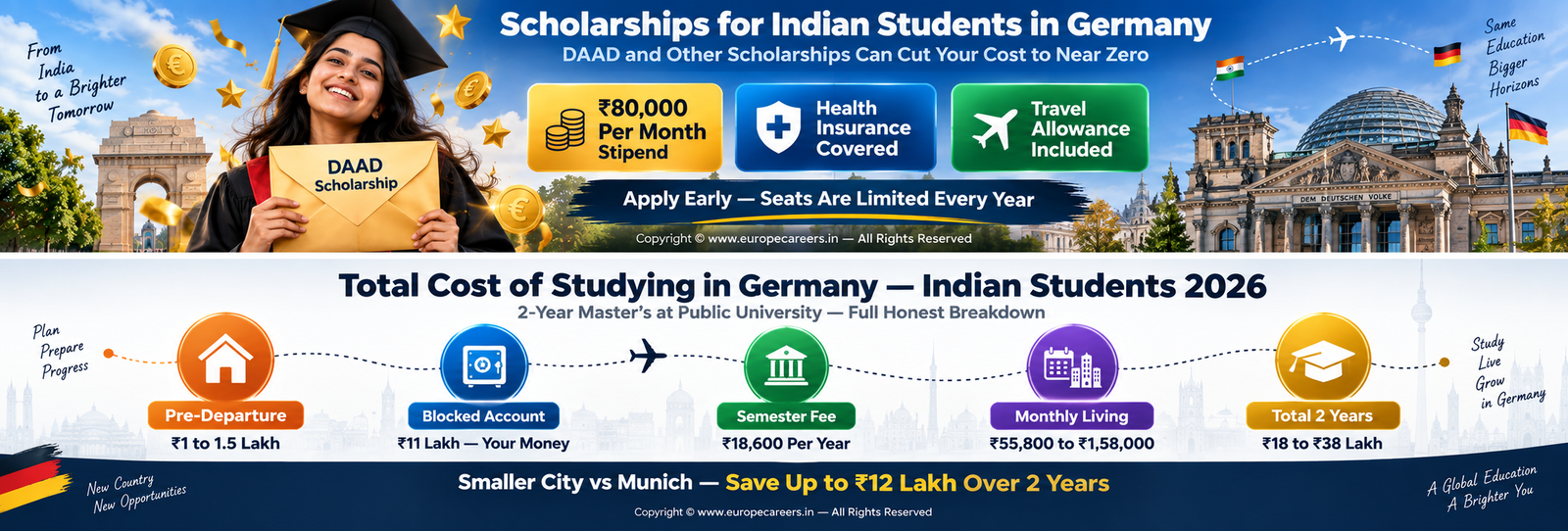
Total approximate before-departure cost excluding blocked account deposit is around 1 lakh to 1.5 lakh Indian Rupees in fees and flight. The blocked account deposit of approximately 11 lakh rupees is on top of this and comes back to you monthly.
Part 2 — Tuition Fees in Germany for Indian Students
This is where Germany becomes very attractive for Indian families.
Public University Tuition Fees — Almost Zero
Most German public universities charge no tuition fees for international students including Indian students. This applies to both bachelor’s and master’s programmes at public universities.
Instead of tuition, every student pays a semester contribution fee every six months. This covers administrative costs, student services, and usually includes a Semesterticket which is a public transport pass valid across the city and sometimes the entire state.
The semester contribution fee typically ranges from 100 to 430 Euros per semester depending on the university and state. In Indian Rupees, that is approximately 9,300 to 39,990 rupees per semester, or 18,600 to 79,980 rupees per year.
For example, at the Technical University of Munich, the semester fee for the winter semester 2025/26 is 85 Euros in Munich, Garching, Weihenstephan, and Heilbronn, rising to 97 Euros from summer 2026. LMU Munich also charges 85 Euros per semester.
This semester fee is not tuition. It is a basic contribution and it includes your public transport pass for the semester, which alone saves you 49 Euros per month on the Deutschland-Ticket.
Exception — Baden-Württemberg State Charges Non-EU Students
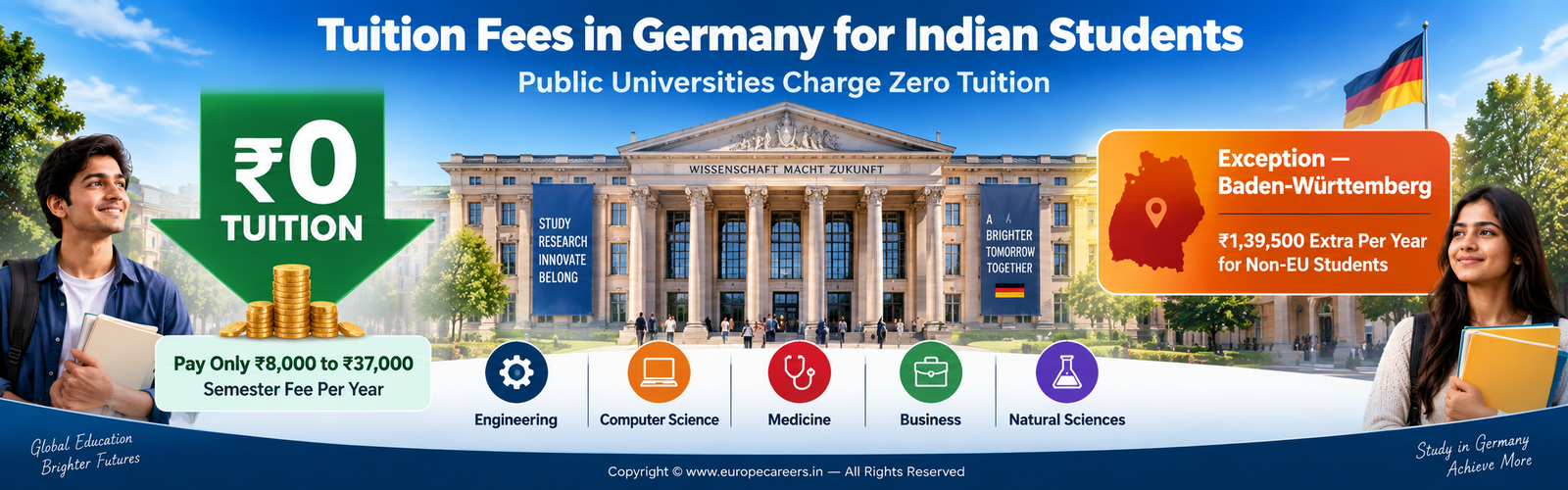
There is one important exception Indian students must know. Universities in the state of Baden-Württemberg, which includes popular cities like Stuttgart, Freiburg, Heidelberg, and Karlsruhe, charge non-EU international students a tuition fee of 1,500 Euros per semester, which is 3,000 Euros per year. In Indian Rupees, that is approximately 1,39,500 to 2,79,000 rupees per year.
If you are applying to Karlsruhe Institute of Technology, University of Freiburg, University of Heidelberg, or University of Stuttgart, factor this extra cost into your budget.
Private University Tuition Fees
Private universities in Germany do charge tuition fees, and they can be significant. Private university fees typically range from 5,000 to 20,000 Euros per year depending on the institution and programme. In Indian Rupees, that is approximately 4,65,000 to 18,60,000 rupees per year.
MBA programmes at private German business schools can cost even more. Always research carefully whether you are applying to a public or private university and what the exact fee structure is before paying any application fee.
Part 3 — Monthly Living Costs in Germany for Indian Students
 This is the real budget that determines how much money your family needs to send you each month. Living costs in Germany vary significantly depending on which city you are in.
How Much Does It Cost to Live in Germany Per Month
Living expenses in Germany for Indian students range from approximately 70,000 to 1,73,000 Indian Rupees per month, or 660 to 1,623 Euros, depending on the city and lifestyle. On average, students need about 1,141 Euros each month for basic needs.
The German government itself bases the blocked account on 992 Euros per month as the minimum living requirement. In reality, most students spend between 850 and 1,200 Euros per month depending on where they live.
Accommodation Costs in Germany
Accommodation is the single biggest monthly expense for Indian students in Germany.
Student Dormitories managed by Studentenwerk are the most affordable option. Typical costs range from 200 to 400 Euros per month in most cities. However, waitlists for dormitory rooms can be very long — in Munich the waitlist is 12 to 18 months. Apply for dormitory accommodation immediately after receiving your admission letter and do not wait.
Shared Apartments called WG or Wohngemeinschaft in German are the most popular choice for students. You rent a single room in a shared flat with other students or young professionals. Costs for a shared apartment room range from 300 to 650 Euros per month depending on the city.
Private Apartments where you live alone cost significantly more, averaging around 828 Euros per month and going up to 1,500 Euros in city centres. This is not recommended for first-year students on a tight budget.
City-wise accommodation costs give you a realistic picture. In Munich, private shared apartment rooms cost 750 to 1,100 Euros per month. Munich is the most expensive German city for students. In Berlin, shared rooms cost 600 to 900 Euros per month. In Hamburg, shared rooms cost 500 to 800 Euros per month. In smaller university cities like Aachen, Dresden, Leipzig, Dortmund, Chemnitz, and Wuerzburg, shared rooms cost 250 to 500 Euros per month, which is significantly cheaper.
Choosing a smaller university city over Munich or Berlin can save you 300 to 500 Euros per month on accommodation alone. Over a two-year Master’s degree, that is a saving of 7,200 to 12,000 Euros, which is approximately 6,69,600 to 11,16,000 Indian Rupees.
Food and Grocery Costs in Germany
Students typically spend approximately 198 to 300 Euros per month on food depending on their eating habits. In Indian Rupees, that is approximately 18,414 to 27,900 rupees per month.
Student cafeterias called Mensa are present at every German university and offer budget-friendly hot meals for just 3 to 4 Euros per meal. They always have vegetarian options which is important for many Indian students. Eating at the Mensa regularly is the smartest way to save money on food in Germany.
Buying groceries from affordable supermarkets like Aldi, Lidl, Penny, and Netto helps keep food costs low. These discount supermarkets are present in every German city and have good quality products at low prices.
Indian students who cook at home typically spend 150 to 200 Euros per month on groceries. Indian spices, rice, lentils, and basic Indian ingredients are available in most German cities at Asian supermarkets or online.
Transport Costs in Germany
Public transport in Germany is excellent and affordable for students. Most universities include a Semesterticket in the semester contribution fee, which allows you to travel free or at very low cost within the city and sometimes across the entire state.
The Deutschland-Ticket is a national monthly transport pass that costs 49 Euros per month and allows unlimited travel on all local and regional public transport across Germany. Many universities include this in the semester fee. If your university does not include it, 49 Euros per month is approximately 4,557 Indian Rupees.
If your Semesterticket is included in your semester fee, your transport cost for local city travel is effectively zero on top of what you already paid. This is a significant saving.
Health Insurance in Germany — Mandatory for All Students
Health insurance is mandatory for every student in Germany. You cannot enrol at a German university without health insurance. You cannot get a student visa without it.
Public health insurance for students under 30 years old typically costs around 120 Euros per month. In Indian Rupees, that is approximately 11,160 rupees per month.
Popular public health insurance providers for international students in Germany include TK (Techniker Krankenkasse), AOK, Barmer, and DAK. TK and AOK are the most commonly used by Indian students.
Some blocked account providers like Fintiba and Expatrio offer a few months of free public health insurance bundled with the account opening. Always check what is included in your blocked account package.
Private health insurance is available as an alternative and can be cheaper at around 30 to 60 Euros per month. However, private health insurance has limitations and is not accepted by all German universities for student enrolment. Always confirm with your university before buying private health insurance.
Study Materials and Books
Books, course materials, printing costs, and stationery typically cost around 20 to 30 Euros per month for most students. In Indian Rupees, that is approximately 1,860 to 2,790 rupees per month.
Many German universities provide free access to digital textbooks and academic databases through the university library. Use these resources to reduce your book spending significantly.
Phone and Internet Costs
A basic German SIM card with data typically costs 10 to 20 Euros per month. In Indian Rupees, that is approximately 930 to 1,860 rupees per month. Popular affordable providers include Aldi Talk, Lidl Connect, and O2. University residences usually include internet in the rent.
Personal Expenses and Entertainment
Personal expenses including clothing, toiletries, social activities, cinema, gym membership, and occasional dining out typically cost 50 to 150 Euros per month depending on your lifestyle. In Indian Rupees, that is approximately 4,650 to 13,950 rupees per month.
German cities offer many free and low-cost activities for students including museums, parks, free student events, and cultural festivals. With a student ID card, you can access significant discounts across cinemas, theatres, museums, restaurants, and train tickets.
Part 4 — City-Wise Monthly Budget for Indian Students in Germany
 This section helps you plan your exact monthly budget based on which city you will study in.
Monthly Budget in Munich
Munich is the most expensive student city in Germany. It is home to the Technical University of Munich and LMU Munich, which are Germany’s top two ranked universities. Living here costs more but the job market is also the strongest.
Accommodation in a shared flat costs 750 to 1,100 Euros per month. Food and groceries cost approximately 200 to 300 Euros per month. Health insurance costs approximately 120 Euros per month. Transport through Semesterticket is usually included in semester fee. Personal expenses cost approximately 50 to 100 Euros per month.
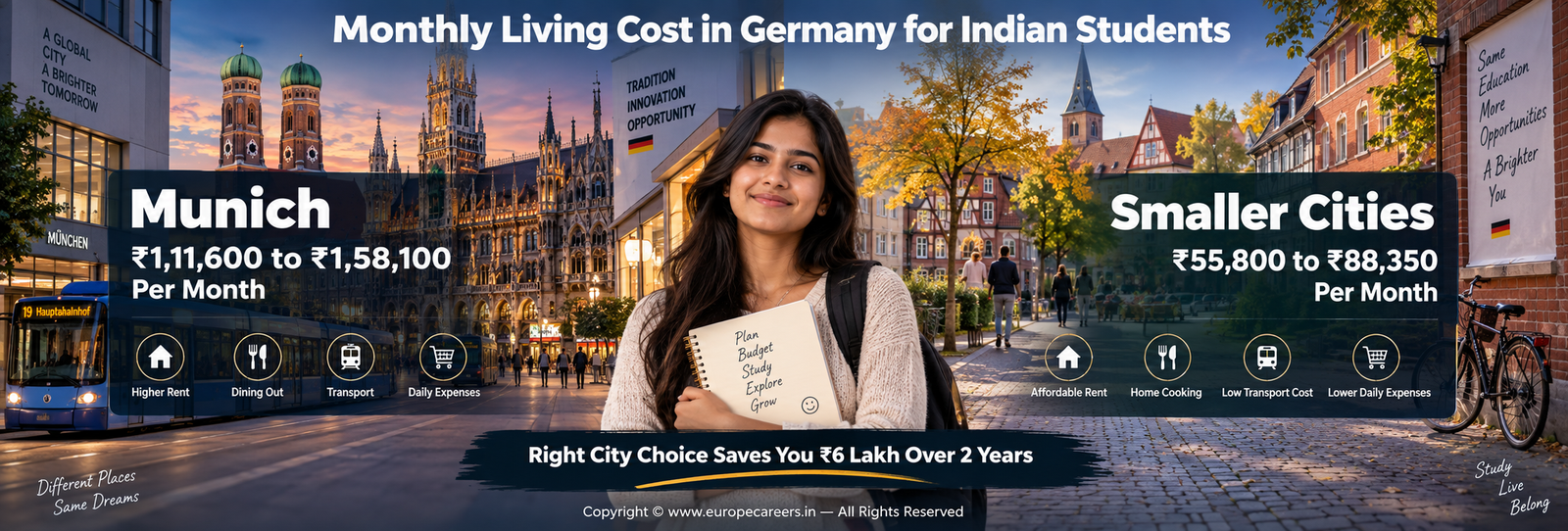
Total realistic monthly budget in Munich is approximately 1,200 to 1,700 Euros per month. In Indian Rupees, that is approximately 1,11,600 to 1,58,100 rupees per month.
Monthly Budget in Berlin
Berlin is more affordable than Munich and has a very vibrant international student culture. It is home to TU Berlin, Humboldt University, and Free University of Berlin.
Accommodation in a shared flat costs 600 to 900 Euros per month. Food and groceries cost approximately 200 Euros per month. Health insurance costs approximately 120 Euros per month. Transport is often included in semester fee. Personal expenses cost approximately 50 to 100 Euros per month.
Total realistic monthly budget in Berlin is approximately 1,000 to 1,350 Euros per month. In Indian Rupees, that is approximately 93,000 to 1,25,550 rupees per month.
Monthly Budget in Smaller University Cities
Smaller cities like Aachen, Dresden, Leipzig, Dortmund, Chemnitz, Wuerzburg, Erlangen, and Kaiserslautern offer the most affordable living in Germany for students. These cities have excellent universities but cost significantly less than Munich or Berlin.
Accommodation in a shared flat costs 250 to 500 Euros per month. Food and groceries cost approximately 150 to 200 Euros per month. Health insurance costs approximately 120 Euros per month. Transport is usually included in semester fee. Personal expenses cost approximately 50 to 100 Euros per month.
Total realistic monthly budget in smaller cities is approximately 600 to 950 Euros per month. In Indian Rupees, that is approximately 55,800 to 88,350 rupees per month.
Choosing a smaller city over Munich can save your family 3,00,000 to 6,00,000 Indian Rupees per year in living costs alone while still giving you a globally recognised German degree.
Part 5 — Total Cost of Studying in Germany for Indian Students
Now let us put it all together with a complete picture of total costs.
Total Cost of a 2-Year Master’s Degree in Germany
This is the most popular choice for Indian students in Germany — a 2-year Master’s degree at a public university.
The total 2-year cost of doing a Master’s degree at a public German public university is approximately 22.5 lakh to 25 lakh Indian Rupees total, covering 100 percent of living expenses, rent, food, health insurance, and administrative fees.
This breaks down as follows. One-time before-departure costs including APS fee, visa fee, flight, and setup costs are approximately 1 lakh to 1.5 lakh Indian Rupees.
Blocked account deposit is approximately 11 lakh Indian Rupees. Remember this is your own money returned to you monthly — not a fee — so it is not a net loss.
Tuition and semester fees at a public university for 2 years are approximately 18,600 to 79,980 Indian Rupees per year, making it 37,200 to 1,59,960 Indian Rupees total for 2 years. At Baden-Württemberg universities with the non-EU surcharge, this goes up to approximately 5,58,000 Indian Rupees for 2 years.
Monthly living costs for 24 months in an affordable city like Dresden or Aachen at approximately 700 Euros per month equals 14,400 Euros over 2 years, which is approximately 13,39,200 Indian Rupees.
Monthly living costs for 24 months in Munich at approximately 1,400 Euros per month equals 33,600 Euros over 2 years, which is approximately 31,24,800 Indian Rupees.
So the total out-of-pocket cost of a 2-year Master’s in Germany at a public university, not counting the blocked account money that returns to you, is approximately 15 lakh to 33 lakh Indian Rupees depending on your city choice. This is significantly more affordable than the UK or Australia where tuition alone can cost 25 to 40 lakh rupees per year.
Total Cost of a Bachelor’s Degree in Germany
A bachelor’s degree in Germany is typically 3 years for German-taught programmes. For Indian students doing English-taught bachelor’s programmes, duration is also usually 3 years.
The total cost of a 3-year bachelor’s degree at a German public university is approximately 25 lakh to 45 lakh Indian Rupees total, depending on the city.
The main cost driver is not tuition — it is 3 years of living expenses, which add up to a significant amount. The more affordable your city choice, the lower this total becomes.
Total Cost of an MBA in Germany
MBA programmes at German universities are different. Many MBA programmes are offered by private institutions or through special executive programmes and do charge tuition fees.
MBA tuition fees in Germany range from 10,000 to 30,000 Euros for the full programme. In Indian Rupees, that is approximately 9,30,000 to 27,90,000 rupees for the course itself.
Add living costs on top of this. A 1-year MBA in Berlin or Munich with living expenses would cost approximately 15 lakh to 35 lakh Indian Rupees total.
Part 6 — Ways to Reduce Your Costs While Studying in Germany
Scholarships for Indian Students in Germany
The German Academic Exchange Service, known as DAAD, is the most important scholarship provider for Indian students going to Germany. DAAD offers multiple scholarship programmes specifically for Indian students at both master’s and PhD level.
The DAAD scholarship covers tuition fees where applicable, a monthly stipend of 861 Euros for Master’s students and 1,200 Euros for PhD researchers, health insurance contribution, travel allowance, and study and research allowance.
Other important scholarships include the Heinrich Böll Foundation, Friedrich Ebert Foundation, Konrad Adenauer Foundation, and Hanns Seidel Foundation. Each foundation awards scholarships based on academic merit and sometimes political or social engagement criteria.
Many German universities also offer their own internal scholarships and Deutschland-Stipendium awards of 300 Euros per month funded jointly by the university and private sponsors.
Indian students with strong academic records should apply to at least 2 to 3 scholarship programmes before or alongside their university applications. Winning even a partial scholarship significantly reduces the financial burden on your family.
Part-Time Work in Germany
Indian students are allowed to work 120 full days or 240 half days per year in Germany during their studies. This translates to approximately 20 hours per week during the semester.
Minimum wage in Germany as of 2026 is 12.82 Euros per hour. Working 20 hours per week at minimum wage earns approximately 1,025 Euros per month before tax. In Indian Rupees, that is approximately 95,325 rupees per month.
This income can cover a significant portion of your monthly living expenses, especially if you are in an affordable smaller city. Many Indian students in Germany cover 50 to 70 percent of their monthly expenses through part-time work.
Popular student jobs in Germany include research assistant positions at universities called HiWi jobs, working in university cafeterias, IT support roles, tutoring, customer service, and internships in your field.
Choose an Affordable City
As shown in the city-wise budget section above, choosing to study in a smaller university city like Aachen, Dresden, Leipzig, or Chemnitz instead of Munich can save your family 3,00,000 to 6,00,000 Indian Rupees per year. Over a 2-year Master’s, that is a saving of 6 lakh to 12 lakh rupees without compromising on degree quality since Germany’s university quality is high across the country.
Education Loans for Germany from India
Several Indian nationalised banks and private NBFCs offer education loans specifically for students going to recognised German universities.
State Bank of India, Bank of Baroda, Axis Bank, and HDFC Credila are among the most commonly used lenders for Germany education loans. Loan amounts typically range from 20 lakh to 75 lakh rupees depending on the institution and your financial profile.
Since total costs for Germany are significantly lower than UK or Australia, the loan amount needed is also much lower and more manageable in repayment. Many Indian students who graduate from German universities and find jobs in Germany with salaries of 40,000 to 70,000 Euros per year can comfortably repay their education loans within 3 to 5 years.
Part 7 — Complete Money Checklist Before Applying to Germany
This is your complete financial checklist before you start the Germany application process.
Do you have approximately 18,000 Indian Rupees ready for the APS certificate fee? This is the first payment you make.
Do you have approximately 11 to 12 lakh Indian Rupees available for the blocked account deposit? This money is yours and comes back monthly, but it must be available upfront before your visa interview.
Do you have approximately 89 to 159 Euros available for blocked account setup and provider fees?
Do you have 75 Euros for the Germany student visa fee?
Do you have funds for a flight ticket from India to Germany ranging from 45,000 to 90,000 Indian Rupees?
Do you have a monthly budget plan that covers your city’s realistic living costs ranging from 55,000 Indian Rupees per month in smaller cities to 1,60,000 Indian Rupees per month in Munich?
Have you checked if your target university is in Baden-Württemberg state where an extra 1,500 Euros per semester non-EU tuition fee applies?
Have you researched DAAD scholarships and other German scholarship options and set application deadlines in your calendar?
Have you factored in health insurance costs of approximately 120 Euros per month, which is mandatory and cannot be skipped?
Final Answer — How Much Money Do You Really Need
 Here is the simplest honest answer for Indian students and families.
To study a 2-year Master’s degree in Germany at a public university in an affordable smaller city, your total budget should be approximately 18 lakh to 22 lakh Indian Rupees for the full 2 years. This includes all one-time costs, blocked account, living expenses, and semester fees.
To study a 2-year Master’s degree in Germany at a public university in Munich or Berlin, your total budget should be approximately 28 lakh to 38 lakh Indian Rupees for the full 2 years.
These amounts sound large but remember that part-time work income can cover 50 to 70 percent of your monthly expenses, scholarships can reduce costs further, and the blocked account deposit of approximately 11 lakh rupees is your own money that comes back to you monthly — it is not a fee you are losing.
Germany is not the cheapest European country to study in, but it gives you one of the best returns on investment. Zero or near-zero tuition at world-ranked universities, an 18-month post-study work visa, and access to Europe’s largest economy with average graduate starting salaries of 40,000 to 55,000 Euros per year — the financial investment in a German degree pays back significantly faster than many other destinations.
To explore European study and career opportunities for Indian students and professionals, visit www.europecareers.in.